Psychic Products
Further developments and forum discussions
Let us begin with our minimal certainty: we sometimes perceive something changing. I abbreviate “something” as sth here. It is the starting point of the table. Since I call everything that exists in itself CELA, these acts of perception take place within the Real. I then ask how lived experience is organized. In the table below, I propose eight levels for exploring this question, from felt intensity to the context in which it takes on meaning.

To name these perceptions, I borrowed several terms from William T. Powers’s hierarchy, which I had first encountered through William Glasser. I had already calculated the compositions when I returned to this hierarchy and chose labels that fit them, even if imperfectly. The terminology helps make sense of the construction. Its rules and ranks had already been established.
The borrowing is limited to the labels of the first seven levels. The CdR framework gives them its own definitions and does not adopt Powers’s perceptual control theory. I added “Context” for the eighth level.
Here I apply to perception the same process of progressive complexification as for physical products. I find eight levels of discernment, from intensity to context. A sensation, a configuration, a transition, a relation, a principle, a system, or a context can be perceived directly, without our having to unfold the compositions that allow us to describe them.
If I stop at eight, it is not a choice of presentation. Beyond context, I find no new perception with this unity of its own, nor any term in the languages I have examined to designate one. Compositions can extend indefinitely, but they then combine perceptions already present at lower levels. I therefore consider that fundamental perceptions stop at the eighth level.
At the fifth level, I use conscious for a reflexive relation: perception itself enters into what is perceived. At the sixth, I use consciousness for the organizing principle of lived experience that I propose on the basis of this relation. Reflexivity offers a way to explore that organization.
From this structure, it follows that perception necessarily implies existence, but that the reverse is not true. The perception of perceiving — formulated as (sth feels sth) — is made up of less complex elements than the perception of existing — (being sth). By regrouping the first two elements ((sth feels) sth), one shows that perceiving implies being; but to establish the reverse, one would have to decompose being sth, which may designate either an object ((feels sth) sth) or a subject ((sth feels) sth). Thus, depending on how one combines and recombines the elements of one and the same perception, one passes from one truth to another, without these truths being immediately reducible to one another. The following table illustrates this combinatorial logic.

By manipulating the basic elements of what is perceived (sth, feels, being), one recovers the main notions of the ontological universe of discourse — existence, consciousness, perceiving agency, and so on. This same method can be applied to other domains of experience: for example, to the adjective “intense” in the thermal field. There one again finds structural correspondences between physical, perceptual, and linguistic notions.
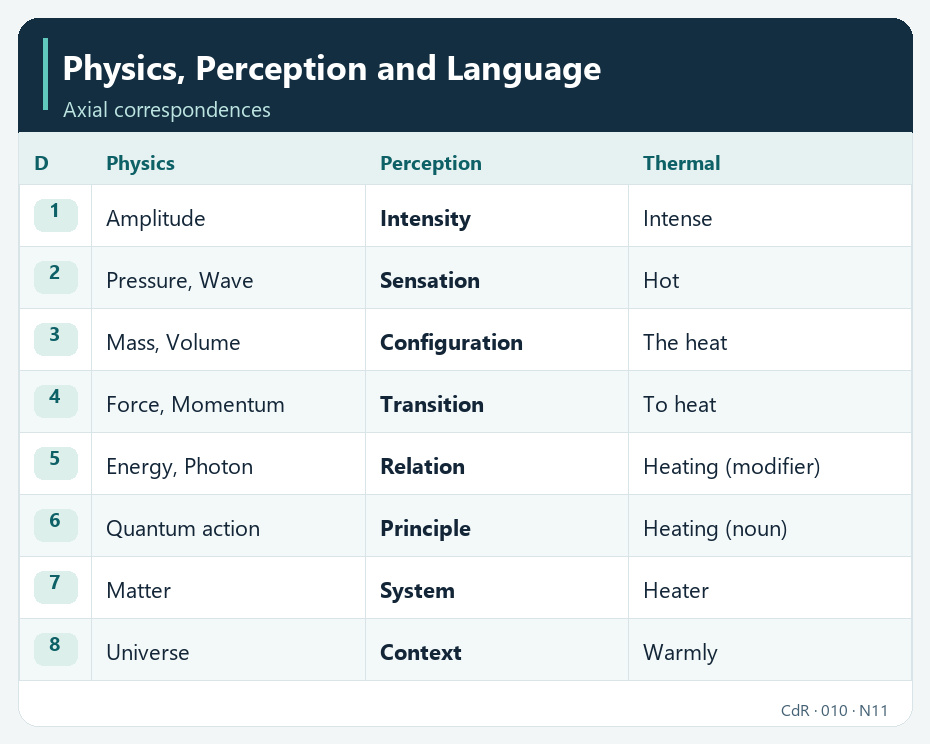
Take particular note of the correspondence between physical, perceptual, and thermal notions. I see it as an expression of the Substance of the Real’s nature as both physical and perceiving. Conscious perception does not originate primarily in the brain: it belongs to the substance that gives rise to all spatial and material reality. The brain enables a biologically organised manifestation of it. Since discernment is organised according to the very structure of the Real, I find this organisation even in the words used to express it. I could give other examples (D2: just ⟶ the just or judge ⟶ to judge ⟶ judgeable ⟶ justice ⟶ judicial ⟶ judiciously), but the best way I know to show it still lies in the use of a neologism. For example:
Semantic gradient of “bob” (D2–D8)
-
D2 — bob (sensation)
Immediate quality: direct qualifier expressing a sensible property or a perceived state.
Example: a bob atmosphere. -
D3 — Bob (object/subject configuration)
Individual entity: a particular instance embodying the quality “bob.”
Example: that Bob manifests the essence of bob. -
D4 — to bob (transition)
Action / process: the act of manifesting bob, of producing or operating according to that quality.
Example: he bobs as soon as he expresses himself. -
D5 — bobbing / bobbable (relation)
Bobbing describes what expresses bob in an interaction. Bobbable describes what lends itself to that expression.- Bobbing — A bobbing presence makes bob felt as the conversation unfolds.
- Bobbable — A bobbable conversation gives the participants a chance to express bob.
-
D6 — bobism (principle)
Operative principle: structuring archetype at the origin of bobic manifestations.
Example: bobism is not an ideology, but the internal law of bob. -
D7 — bober (system)
Organization of the principle: operating system or structuring agent of the bobic principle.
Example: the bober realizes and systematizes bobism. -
D8 — bobly (context)
Field of expression: ontological context or global mode in which bob is expressed.
Example: to act bobly = to act within the field of bob.
I have already compared how these distinctions are expressed in different languages. The forum discussions extended that exploration in the thermal and judicial domains by proposing examples for each of the eight roles. These examples were chosen after the roles had been assigned. To take this further, I would like to see how speakers classify statements collected in their own language without knowing the expected classification.
I have also explored this scheme beyond everyday language, in economic language, mathematics, and the language of set theory. In each case, I ask whether the eight levels help distinguish the roles that concepts play in their domain. Disagreements about classification are part of the inquiry: they require me to specify what each level helps distinguish.
Before you continue. Do this exercise now, before reading the chapter Perception. That chapter introduces the orientations these approaches refer to. Reading it first may influence how you rank them.
Would you like to feel warmer? Imagine all six approaches are possible. Rank them from most to least appealing. Ties are allowed. Write down your ranking, then write one sentence about what draws you to your first choice and one about what makes your last choice less appealing. Keep your answers so you can revisit them after reading the chapter.
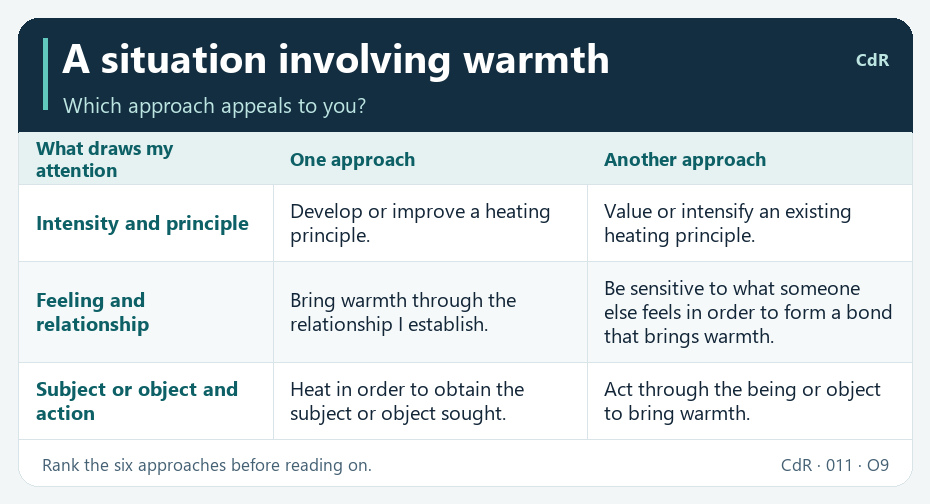
Once you have written down your ranking and both sentences, continue to the chapter Perception. You can then return to your initial answers.
Further exploration
To examine the first perceptual and psychic structurings of the CdR model:
- image008 — Perceptive Hierarchy — Internal Organization of Experience
- image009 — Reflexive Compositions — Formal Weight, System, and Context
- image010 — Correspondences — Physics, Perception and Language
- image011 — Six Approaches to Recognising Your Spiritual Orientation
These documents develop the hierarchy of lived experience, reflexive saturation, cross-domain correspondences, and different ways of approaching the same goal.