Fundamental Structure
In Consciousness of the Real, we have seen that the entirety of reality could be the product of a single substance: CELA, dynamic and self-complexifying. This substance is not passive: by extending along various dimensional axes, it generates not only spaces but also all fundamental physical notions. The point here is not to assume multiple separate entities or forces, but to show how a single reality, exploiting different degrees of freedom, can generate the diversity of the world.
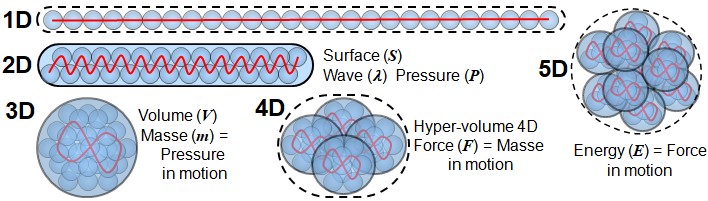
In other words, at each level of interaction between dimensional structures, new physical notions naturally emerge. Here is another way to represent them. It will soon allow us to approach the question of particles—not as isolated objects, but as dynamic and relational configurations of CELA in multidimensional spaces.
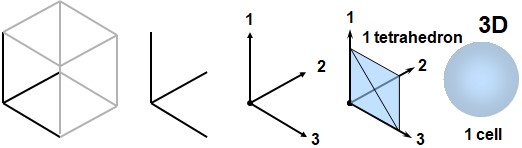
Starting from a simple three-dimensional cube, one selects three of its edges meeting at a point of origin: these are our first three dimensional axes, denoted here 1, 2, and 3. If each axis is considered to be filled with the substance CELA, then the volume delimited by these three directions forms a tetrahedron (a quarter pyramid), which can be regarded as a cell of the substance of the Real in 3D space.
This tetrahedral cell possesses:
- 3 axes (1, 2, 3) — directions of expansion of the substance,
- 3 surface faces (called 2-faces): the pairs 1-2, 1-3, and 2-3,
- 1 volumetric face (3-face): the combination 1-2-3.
This basic cell will serve as a unit to understand:
- internal relations between the components of a physical system,
- interactions with neighboring cells,
- the genesis of notions such as force, energy, or particle structure.
By adding a fourth dimensional axis (axis 4) to the first three, the substance CELA is allowed to occupy a new direction of expansion, opening the possibility for the coexistence of multiple volumes within the same hyperspace.
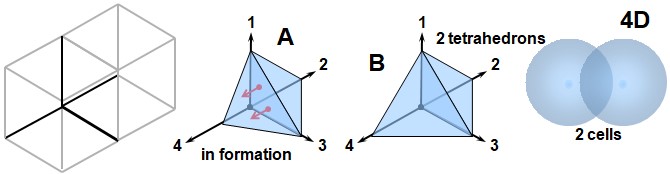
In illustration A, we see two volumes (tetrahedra)—the first, based on axes 1-2-3, and the second, forming on axes 1-3-4. These two volumes share the same volumetric surface (face 1-3), shown here by red arrows, and can therefore interact dynamically through this common interface.
Once formation is complete (illustration B), these two cells are linked by this shared face, and any internal variation of density or pressure in one (for example an internal wave) can affect the other. This interaction—an induced motion of one volume by another—is what corresponds to what we call a force in our physical world.
Thus, force is not an addition to the physical world, but an inevitable geometric effect of the expansion of CELA along a fourth dimensional axis.
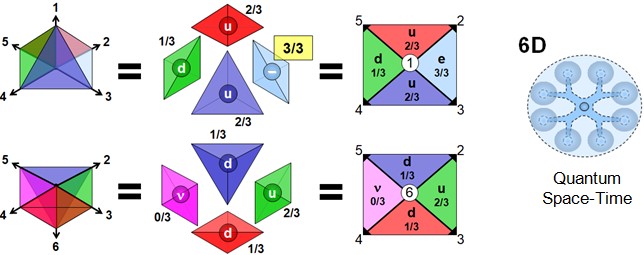
With the addition of two further axes (axes 5 and 6), the structure formed by the initial volumes becomes even more complex. One can then represent eight tetrahedral volumes, each sharing one or more edges with a central volume (formed on axes 1-2-3), which allows one to calculate how many axes each volume shares with it.
The results—0/3, 1/3, 2/3, 3/3—coincide exactly with the electric charges known in the Standard Model:
- 0/3 ⇒ neutrino (neutral)
- 1/3 ⇒ down quark (d)
- 2/3 ⇒ up quark (u)
- 3/3 ⇒ electron (e⁻)
These configurations emerge naturally from the topology of interconnected volumes in six-dimensional space. They are therefore not arbitrary properties added to particles, but direct effects of the degree of dimensional overlap between elementary CELA cells.
This suggests that:
- Elementary particles are not localized objects, but dynamic configurations of CELA volumes distributed in a multidimensional spacetime.
- The quantum of volume/matter would not simply be a “packet of energy,” but a cell of reality, simultaneously field and form, localization and dynamic structure.
- The strange behaviors of the quantum world (indeterminacy, superposition, entanglement…) could be explained naturally as the effects of the coexistence of these cells across multiple intertwined spatial and temporal dimensions.
In other words, the physical world and spacetime itself would be made of CELA, contracted and combined according to precise geometric patterns. What precedes suggests that we—and the space in which we evolve—are made of these elementary cells, these quanta of CELA, rather than of a “fabric” of empty space or separate objects. Each cell represents a quantum of volume and mass, produced by the exploitation of six spatial and temporal axes.
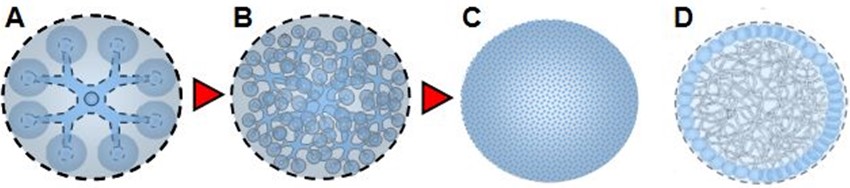
It would be mistaken to imagine these cells as neatly arranged beads or Lego bricks. These entities do not exist as fixed, localized structures, but as dynamic and superposed forms, characteristic of quantum mechanics. There is no empty space between them, nor sharp boundaries or rigid bonds. They are entangled, subtly interconnected, and fluctuating.
Figure A—showing eight well-ordered cells around a center—is misleading. A more faithful representation would be that of a dense, undulatory, foamy network, as in B and C. These unstable and partially defined cells interact through their three-dimensional faces, but they themselves represent only local projections of a more global, more complex object—probably inconceivable without a geometry beyond our usual spacetime.
Figure D attempts to sketch this idea: a kind of quantum foam without void, where the state of one cell cannot be altered without instantaneously affecting other cells at a distance. This vision is compatible with experimentally observed quantum entanglement: quanta would be local manifestations of an indivisible global system, where modifying one link entails an immediate structural reorganization of the whole.
In other words, the world we perceive as made of separate particles and empty space would in reality be a vast wave, composed of coordinated fluctuations of a single conscious substance—an embodied wave within the very structure of CELA.
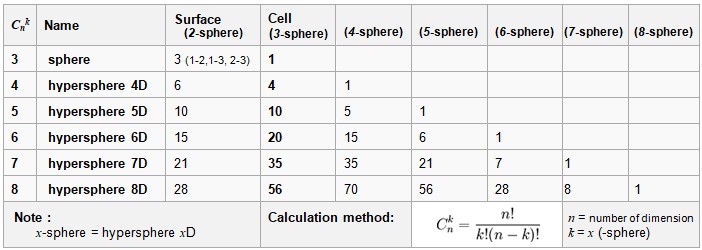
As the table above shows, a six-dimensional hypersphere (6D) contains not eight, but twenty distinct three-dimensional cells. In other words, the 6D hyper-volume is composed of 20 volumetric charges, each corresponding to a unique combination of three axes among the six available.
This reinforces the idea that elementary particles—such as quarks, electrons, or neutrinos—are not point-like entities, but modes of organization of these cells in a higher-dimensional space, each being a quantum of mass, energy, or interaction.
That said, to preserve clarity of exposition and avoid unnecessarily overloading the explanations, we will continue to use the simplified eight-cell model whenever it suffices to illustrate a principle or structure. This minimal model remains pedagogically effective for understanding the basics of this cosmic architecture, even if it does not capture the full richness of the underlying system.
Further reading
The illustrations on this page are based on the detailed technical documents of the Fundamental Structure series:
- image006 — Geometric hierarchy of physical quantities — proto-forms and combinatorics C(N,k)
- image018 — Visual convention 1D → 2D → 3D — axis, plane, tetrahedron, cell
- image019 — Extension of structure toward a multi-volumetric framework
- image020 — 6D structure — Closed prototype, derivations, and numerical validation
- image021 — Generation of a 6D network — quasi-infinite extension, ST interfaces, and global coherence
- image022 — Internal 6D geometry — combinatorial blocks and graph structure
These documents detail the axial and combinatorial construction of the physical framework: proto-forms, visual conventions, multi-volumetric extension, the 6D prototype, network generation, and internal geometry.