Chemistry
Further developments and forum discussions
In CdR, chemistry extends the organization of particles into atoms and molecular assemblies. Electrons and nuclei consist of the same substance as the medium surrounding them. Their chemical relationships must therefore originate in the dynamics of that medium.
From electronic states to bonds
According to my intuition, a bound electron must remain in phase with the disturbances it produces in the medium. Energy levels correspond to the regimes in which this relationship can be maintained around the nucleus. Orbitals would express its spatial organization.
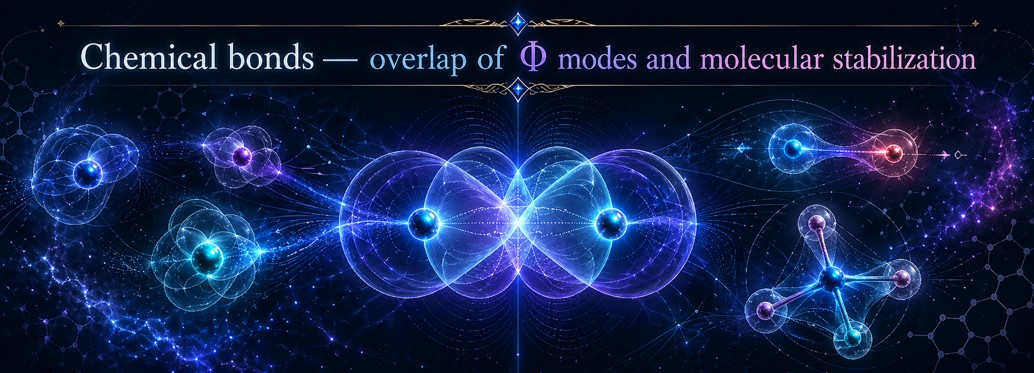
When two atoms approach each other, each changes the conditions under which the other’s electrons can organize themselves. I envisage a chemical bond as the establishment of a shared regime in which electrons, nuclei and their disturbances in the medium form a bound organization.
This interpretation extends that of the associated wave: the electron’s behavior depends on its relationship with an extended disturbance. In a molecule, this relationship can involve several atomic centers. It could thus give physical meaning to electronic delocalization, whose effects sometimes involve an entire architecture.
Form and the medium
A shared organization imposes spatial relationships. Bond directions and molecular shapes would express the conditions of compatibility between the electronic modes of the constituents.
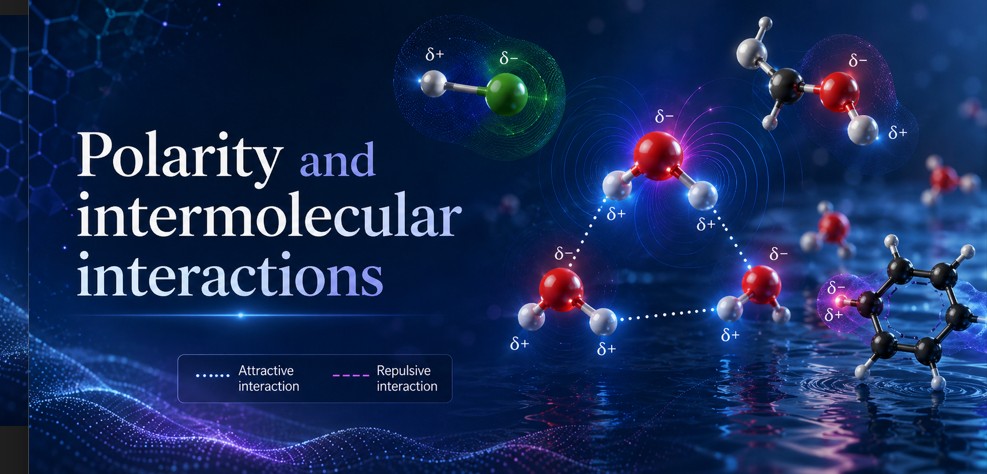
The surrounding medium contributes to these conditions. A neighboring molecule, a solvent or a surface changes the interactions to which the assembly is subjected. The accessible structure thus depends on both its constituents and their environment.
From this perspective, a chemical reaction reorganizes these relationships. A catalyst acts by locally changing the conditions of the transition: it can orient the partners and make accessible a pathway that was previously difficult to follow.
From assembly to sustained organization
Molecules can form networks in which the products of one reaction feed other transformations. When flows sustain these exchanges and compartments retain their constituents, a chemical organization can persist despite the renewal of its matter.
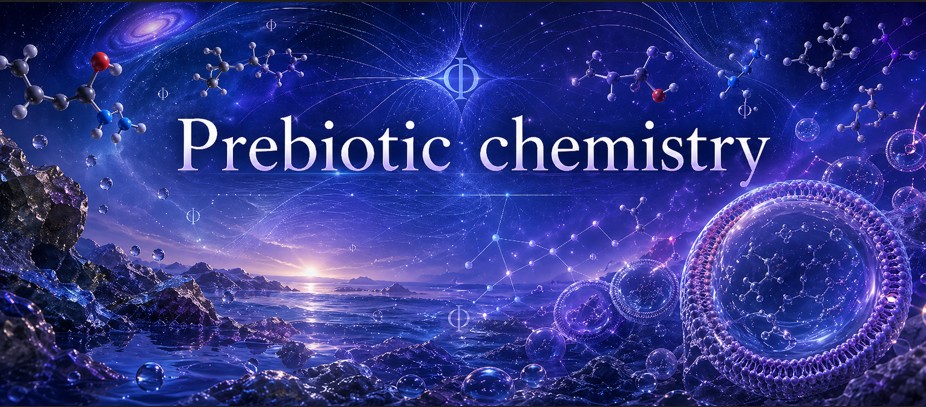
This transition particularly interests me: a material architecture begins to contribute to the conditions of its own preservation. Relationships between its constituents sustain a unity that lasts beyond each individual exchange.
Chemistry thus connects the physics of matter with living systems. In my intuition, this continuity rests on the same spationic medium: it participates in the organization of particles, in relationships between atoms, and then in the exchanges through which material assemblies sustain themselves.
Further exploration
The documents specify the phase-matching intuition, environmental effects and the transition to sustained chemical organizations. They distinguish reference equations from mechanisms CdR has yet to establish.
- image103 — From electronic states to bonds — phase matching and shared organization
- image105 — Form and the medium — geometry, interactions and reaction pathways
- image110 — From assembly to sustained organization — chemical networks and exchanges
These documents clarify the chapter’s proposals, their foundations and the conditions for examining them.