Physical Products
Further developments and forum discussions
To understand what follows, it is necessary to grasp the notion of spatial dimension. We live in a three-dimensional world (3D, e.g. ), where every object has a length, a width, and a height. For example, a box can be described by these three measures. A one-dimensional space (1D, e.g. m or m¹) may be imagined as a straight line, like a ruler. A two-dimensional space (2D, e.g. ) corresponds to a flat surface, like a sheet of paper. Our brain naturally perceives these three dimensions through vision and movement, enabling us to navigate the world. In scientific or philosophical contexts, however, the notion of dimension can extend to more abstract ideas: a fourth dimension (time), or even theoretical dimensions beyond ordinary perception.
Let us now represent the substance of the Real in its simplest conceivable state, and observe how this state complexifies and which physical products and notions emerge from this complexification.
The simplest conceivable state is one in which the entire substance of the Real (here denoted CELA) exists in a condition of maximum density, without internal differentiation.
I represent this state as a point — not in the geometric sense, but as a configuration in which no discernible spatial extension is yet present.

However, by its very nature as a dynamic substance, CELA cannot remain in this state of maximal density. It must extend.
If it extends along one dimensional axis, it forms a line; along two axes, a surface; along three axes, a volume.
But why stop at three axes? Or at four?
A priori, the substance should be able to deploy along as many dimensional axes as necessary to directly reduce its density — that is, to distribute its being more extensively. Yet the calculation of hypersphere volume variation as a function of dimensionality reveals a maximum located between five and six axes:
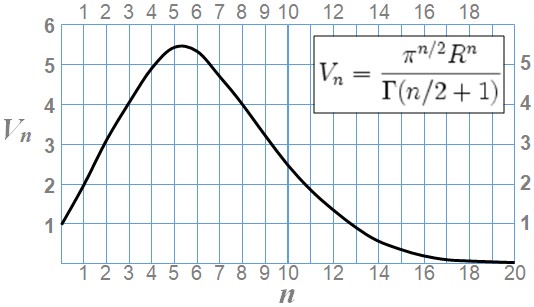
Among integer dimensions, the curve peaks at dimension 5. Let us see what this clue can tell us about how CELA unfolds. Starting from a state of maximal density, illustrated as a point, let us imagine that CELA extends along a dimensional axis:
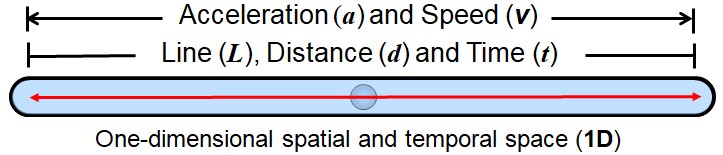
All these physical notions — acceleration, velocity, distance, and time — arise from the exploitation of a single fundamental dimensional axis.
Why include time? Because without time, CELA could not deploy: it would remain in a state of maximal density, without any possible actualization.
This first dimension — simultaneously spatial and temporal — therefore corresponds neither to our Euclidean dimensions (x, y, z) nor to the relativistic model of three spatial dimensions plus one temporal dimension.
Our familiar dimensions of space and time can only be derived products of the fundamental dimensions — effects of the internal dynamics of CELA.
Since CELA exists at every point of the spatial and temporal field it generates, and since this field is finite yet entirely filled by this substance, we may represent each region of space as composed of multiple points of CELA. These points are not isolated, but permanently interrelated.
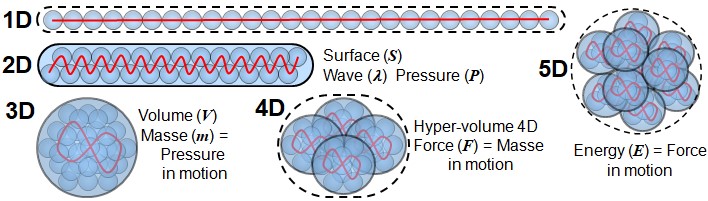
Now imagine this line of points gradually extending from 1D to 5D. Here is how I picture the kinds of organization that could arise as CELA makes use of more axes:
- 1D — A line of points. The first generative axis lets us describe position along the line and measure duration separately. Distance, speed, and acceleration can already be described at this level.
- 2D — A surface made of interacting lines. I imagine waves and tensions here that might give rise to proto-pressure.
- 3D — A volume formed by interacting surfaces. I imagine “pressure in motion” here and call the mass of the substance itself proto-mass, its density being the ratio of that mass to volume.
- 4D — Within a hypervolume, I imagine three-dimensional volumes setting one another in motion through their interactions. This “mass in motion” is what I call proto-force here.
- 5D — The progression continues with “force in motion”, which I associate with proto-energy.
In these images, motion means a variation in the distribution of substance. I imagine extent and density varying with this distribution, and the different portions of CELA interacting as they retract. Additional axes would open new possibilities for organising these dynamics.
The first equations that came to mind, such as and , seemed to confirm this progression. That was more than twenty years ago, when my knowledge of physics came mainly from popular-science accounts. I then extended the check to every equation I could find, including equations I had not previously known.
The table below brings together these initial connections.
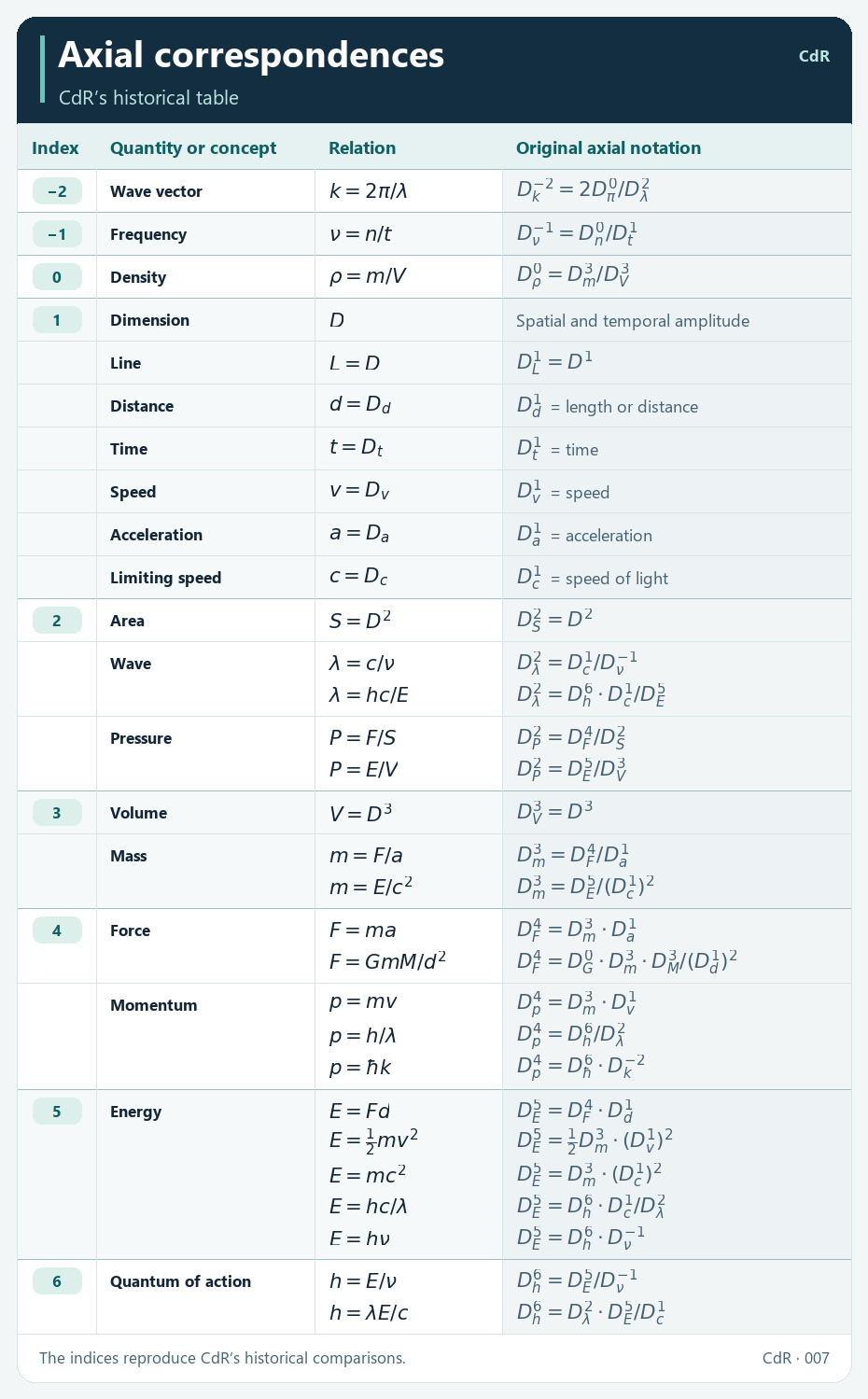
I was deeply impressed to see these equations fall into the same order. For more than twenty years, I believed this calculation applied to every equation in physics. I consulted AIs about it on numerous occasions without their correcting this belief. It was ultimately recent critical exchanges, using more capable models, that brought to light equations that did not follow this progression.
These discrepancies have notably led to a distinction between proto-mass, attributed to the substance, and inertial mass, belonging to matter. This distinction offers a way to investigate the limits of the initial correspondences; it does not yet resolve every difficulty.
In this conception, we do not live within these dimensional spaces: we are made of them, as is the spacetime we inhabit. We shall return to this in the pages devoted to physics. For now, rather than trying to picture a substance unfolding along several dimensions that are both spatial and temporal, let us consider what its psychic products might be.
Further exploration
To examine the first physical transitions of the CdR model:
- image003 — Pre-Metric Configurations — A Boundary to Investigate
- image004 — The Maximum Volume of the Unit Ball — A Benchmark to Justify
- image005 — The Ordinal Axis ST₁ — Succession and Its Limits
- image006 — Axis Groups and Transfer — A Combinatorial Model
- image007 — Axial Correspondences — Scope and Limits of the Table
These documents examine the model’s earliest structures, its geometric reference points, and the conditions needed to connect proto-forms to physical quantities.