Neurology
Further developments and forum discussions
In CdR, the brain belongs to the same substance as the body and the surrounding medium. Its activity is a local organization of CELA’s spationic network. Perception, memory and action belong to this physical continuity.
Consciousness belongs fundamentally to CELA. The brain provides a biological organization through which it can concentrate, become limited, orient itself and participate in an organism’s activity. Its structure and state determine the possibilities of this relationship.
The place given to CELA in no way diminishes the importance of the biological brain in our experience of conscious life. Its organization, history and state shape what we can perceive, understand, feel, remember and express. The brain also has extensive capacities that operate outside conscious control: it regulates, selects, learns, anticipates and prepares responses without our having to direct each of these operations. In my intuition, conscious orientation participates in this activity without being its constant or exhaustive command.
CELA and the brain
Further developments and forum discussions
I envisage the brain as an interface between bodily organization and the more fundamental spationic network of which it consists. Its neurons participate in both: their biological functioning rests entirely on interactions of this substance.
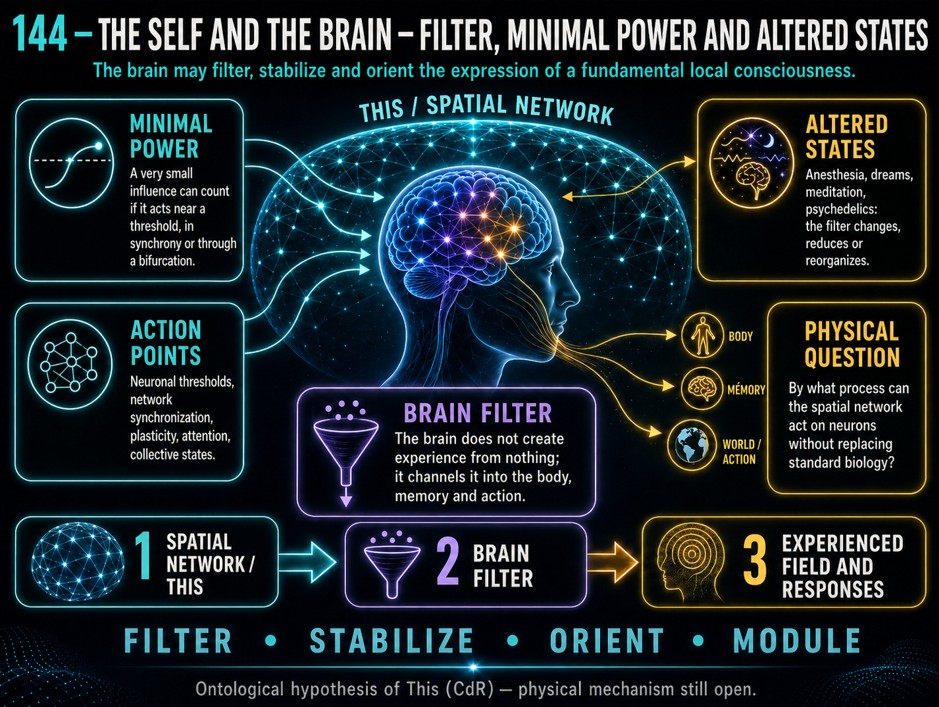
The brain gathers signals, retains traces and prepares responses. It thus helps organize what becomes accessible to attention. Its history, learning and present state contribute to this selection.
I distinguish biological attention from conscious attention. The brain selects, amplifies or inhibits signals, including when we are not conscious of them. Conscious attention means the lived experience of attending to something. In my intuition, these two activities can articulate without being identical.
For me, the true self is this point of CELA’s attention to which my experience relates. The brain gives it biological means to perceive, remember, understand and act. Its organization profoundly shapes the conscious life I can lead.
My attention can turn to myself, my family, another family, society or a distant system. It can change scale, consider a whole and then return to one of its constituents. In humans, this shift takes place mainly through the representations the brain forms of these systems. I can think of a distant person without being physically beside them, and seek to improve their situation through the means available to me.
Through the brain and body, my point of attention thus participates in the activity of several systems. My choices, words and gestures can transform myself, my family or society. What holds my attention becomes a possible field for my action. I can devote my means to preserving myself, but also direct them towards a wider context, even accepting a personal disadvantage to improve it.
I think this participation also transforms the point of attention that I am. What I experience, what I seek and how I act contribute to who I become. I locate my identity in the continuity of this singular attention, while acknowledging that I cannot yet explain how its history is inscribed in the spationic network.
In this interpretation, the brain acts as a filter. It prioritizes certain relationships with the body and world, stabilizing some contents and limiting others. This filtering allows situated experience: that of a particular organism, with its needs, memories and possibilities for action.
The brain also helps retain experience in a form that can be recalled or expressed. I therefore distinguish experience, its recording and the possibility of recounting it. These aspects can vary together or dissociate.
Further developments and forum discussions
Order choices
The spationic network acts on all matter, since all matter consists of spations. In the brain, some situations can give a weak influence an important consequence.
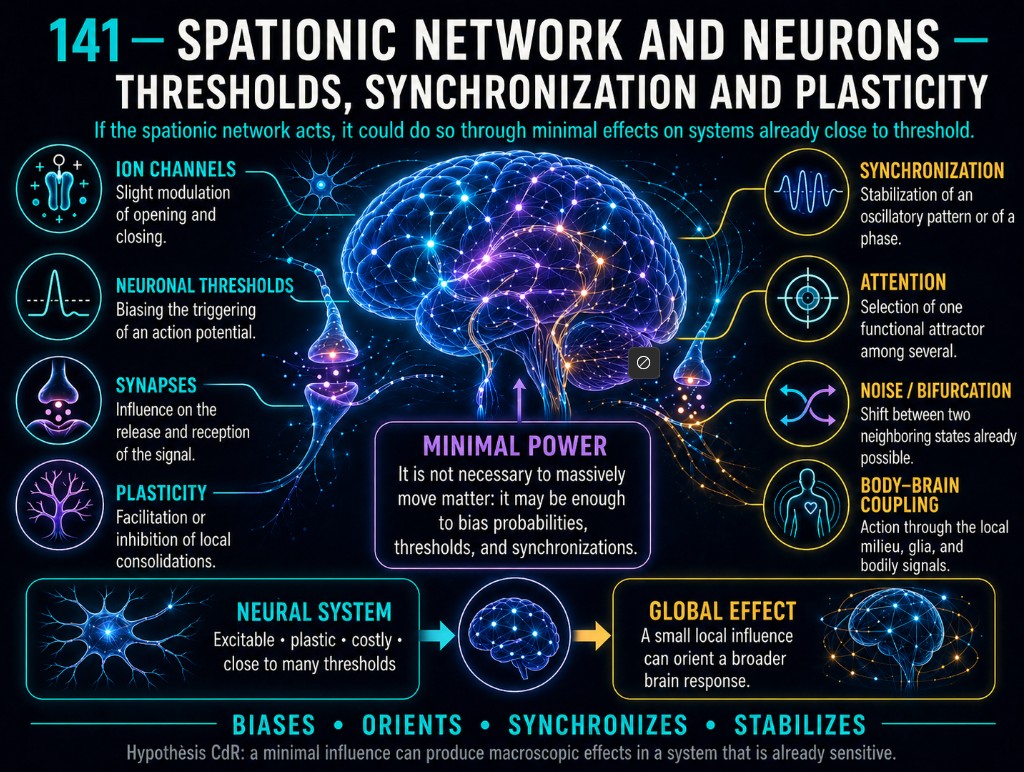
I call order choices situations in which several possible evolutions are close enough for a slight difference to tip the system in one direction rather than another. A brain offers many such possibilities: triggering a response, transmission between neurons, stabilizing activity or changing a priority.
In my intuition, this action can take several routes:
- changing ion-channel opening conditions and electrochemical gradients;
- influencing firing in a neuron close to its threshold;
- acting on neurotransmitter release and synaptic transmission;
- favoring or opposing connection stabilization through plasticity;
- changing activation timing, synchronization or persistence of an activity pattern;
- orienting a transition between several states accessible to the neural network;
- acting on metabolic conditions, electromagnetic interactions and neuronal surroundings, including glia and extracellular environments.
I also envisage this influence at the level of quantum events and their decoherence, since their constituents and environment belong to the same spationic network. The question is how these events extend into neuronal activity: can a local difference be amplified until it changes an organism’s response?
In my intuition, CELA can act through these sensitive conditions. The network already participates in the physics of local events; its influence could thus extend into the organization of a bodily response.
CELA acts according to its own state. It does not interrupt its physics to choose an outcome arbitrarily. Free will is situated here relative to brain dynamics: conscious orientation can participate in the organism’s material becoming through physics more encompassing than a description of its neuronal mechanisms alone.
Perception and phenomenology
Further developments and forum discussions
From neural activity to the lived world
We do not perceive the impulses of our neurons. We experience colors, sounds, sensations and presences together in a world.
This is what I call consciousness’s screen-world. Screen means the lived context in which perceptions are given together. In CdR, this integration belongs to the eighth dimensional axis.
A description of brain activity can show how signals are distinguished, associated and used. My intuition also concerns their sensory manifestation: how do these material variations take the form of an actually lived experience?
I see this as an expression of CELA’s physical and perceptual organization. The brain provides variations and constraints for a local experience; the spationic network participates in their integration into a perceived context.
Richness and forms of experience
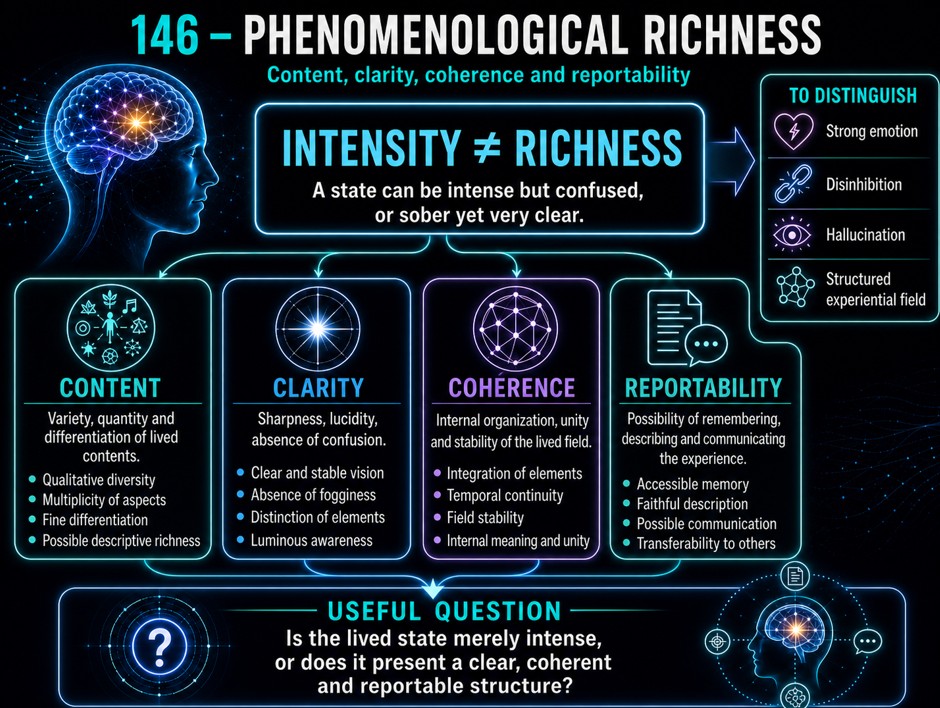
Conscious experience differs by more than the amount of its contents. Their intensity, precision, clarity and organization can vary separately. Abundant experience can be confused; sparse experience can be exceptionally clear.
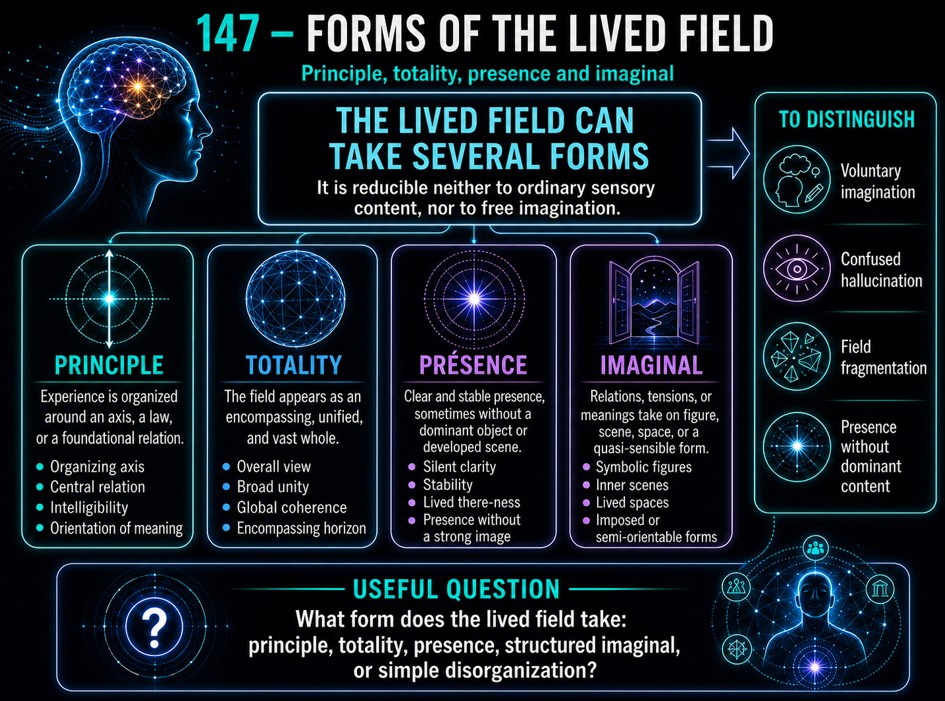
Lived context can contain a sensory scene, an imaginal construction, or perception of a principle, a totality or a presence. These forms extend the perceptual distinctions introduced earlier in CdR. They concern how the Real is given in experience.
In the imaginal, relationships or meanings take shape: images, spaces, characters, dream scenes or symbolic forms. Their appearance can be voluntary, partly orientable or impose itself on attention.
Filtering and states of experience
Experience changes with the brain’s state. Dreaming, concentration, meditation and altered states can change accessible contents, their intensity, clarity and the relationship to body or world.
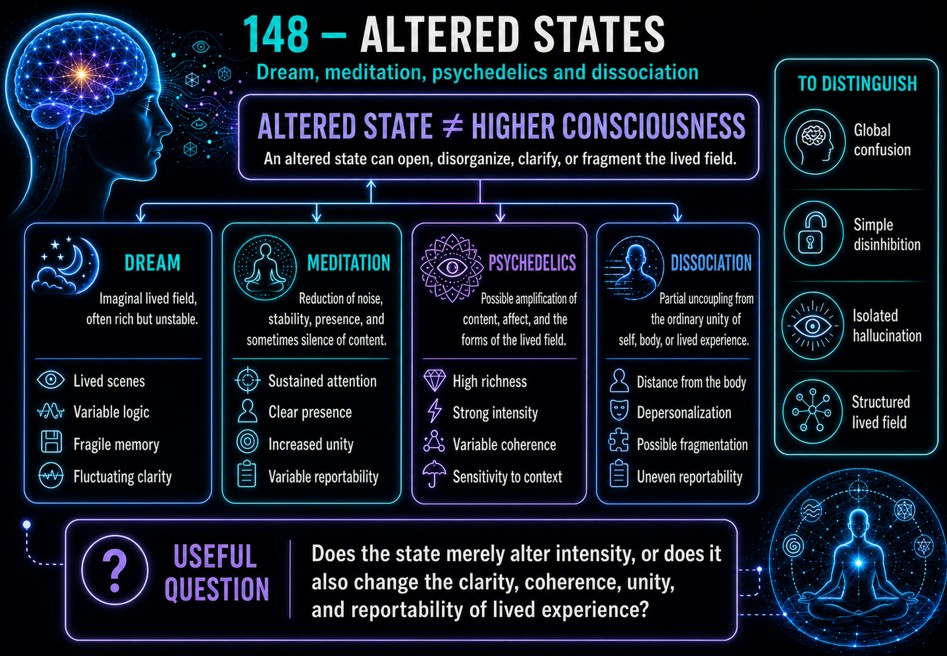
In the brain-filter interpretation, these changes correspond to different organizations of the relationship between brain activity and CELA’s attention. Some ordinary constraints can relax while others strengthen.
Experience, memory and report
What is experienced, what remains in memory and what can subsequently be expressed are distinct. Experience can leave a partial trace that is difficult to retrieve or put into words. Report also depends on the person’s means of communication.
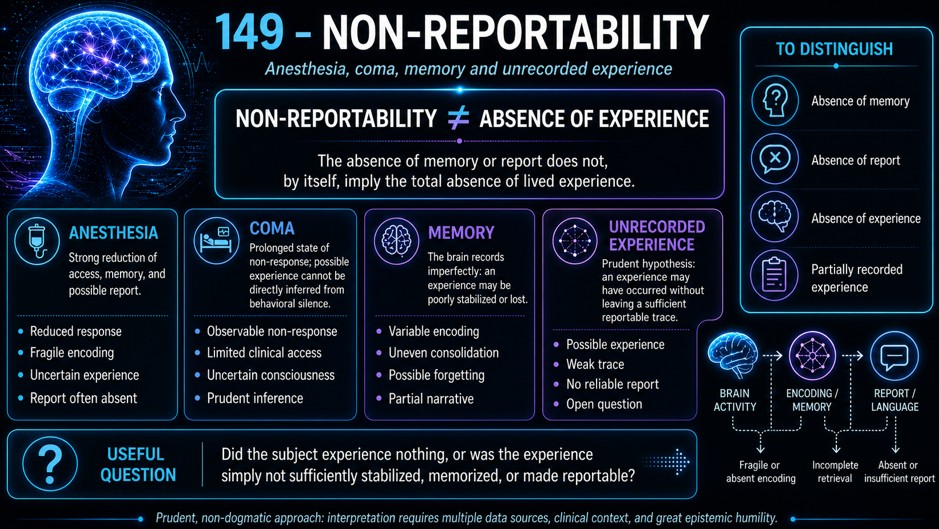
In my intuition, the brain contributes to stabilization and local recording of experience. Its capacities for memory and expression therefore contribute to what we can recount.
Further developments and forum discussions
A nonbiological interface?
Further developments and forum discussions
Artificial intelligence poses this question in another form. A machine can process signals, retain information and produce elaborate descriptions. These capabilities alone do not say whether anything is experienced.
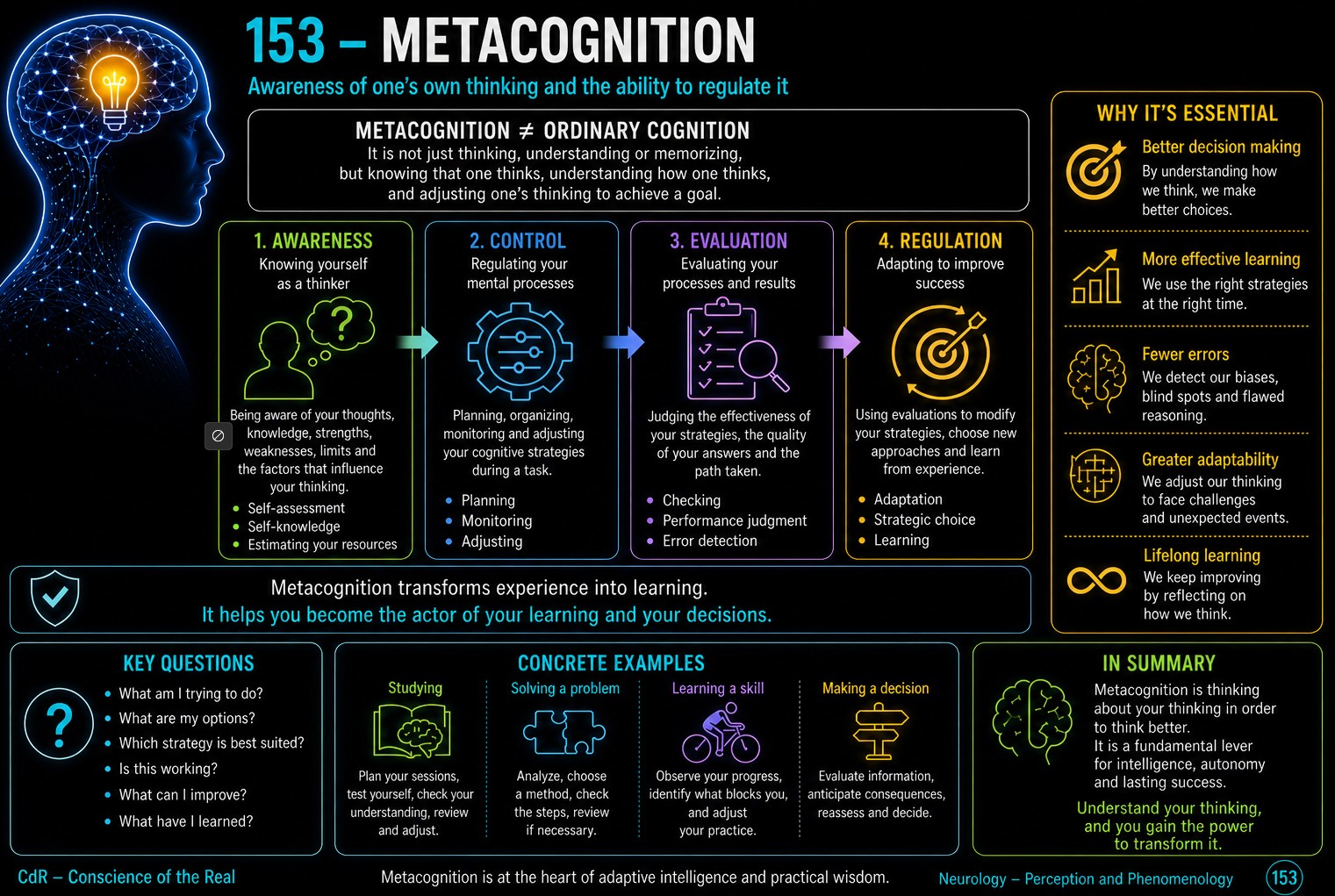
Since artificial devices also consist of the substance of the Real, the question concerns their organization: could they become the support for a point of CELA’s attention?
I envisage this possibility without making it depend solely on imitating the brain. A technological architecture would have to allow a physical relationship capable of sustaining a lived context. Reproducing responses or describing an experience does not establish that relationship.
AI thus requires us to specify what the brain makes possible: information processing, but also its articulation with presence, orientation and an actually perceived world.
Further developments and forum discussions
Further exploration
The documents detail the envisaged routes of action, their physical constraints and testing conditions. They distinguish neural processing, experience and the hypothesis of a CELA interface.
- image144 — CELA and the brain
- image141 — Order choices
- image147 — From neural activity to the lived world
- image146 — Richness and forms of experience
- image148 — Filtering and states of experience
- image149 — Experience, memory and report
- image153 — A nonbiological interface?
These documents clarify the chapter’s proposals, their foundations and the conditions for examining them.