Astrophysics
Further developments and forum discussions
In CdR, astrophysical structures extend the transformations of the medium described in Cosmology. Stars, galaxies and black holes form within a spacetime that participates in their organization. Matter acts on the medium of which it is made, while the pressures, flows and deformations of that medium guide its evolution.
I therefore envisage astrophysics as the study of CELA’s large-scale organizations: how they concentrate, sustain their activity, transform and redistribute their constituents.
From the bounce to cosmic relief
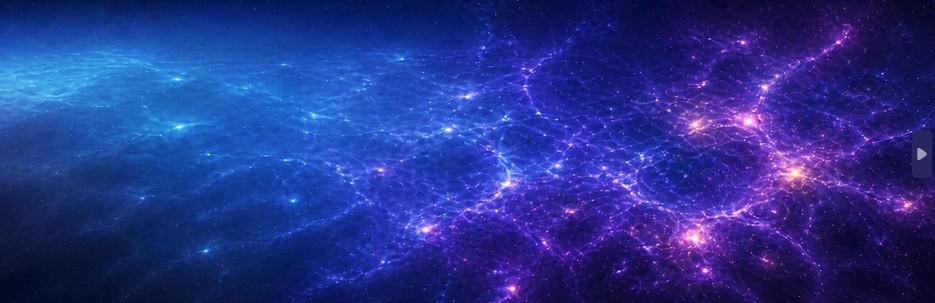
After the Great Bounce, dimensional reopening restores spacetime and then permits protomatter to appear. Astrophysical structures develop in this renewed medium. Any continuity between cycles would pass through CELA’s state and correlations capable of reappearing after the bounce, rather than through the intact preservation of stars or galaxies.
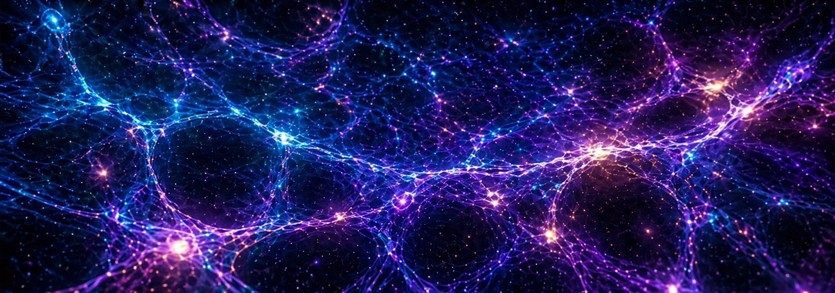
Protomatter can be widely distributed without every region being identical. Local differences in density, pressure and organization introduce different evolutions. Some compensate one another; others persist, strengthen or propagate.
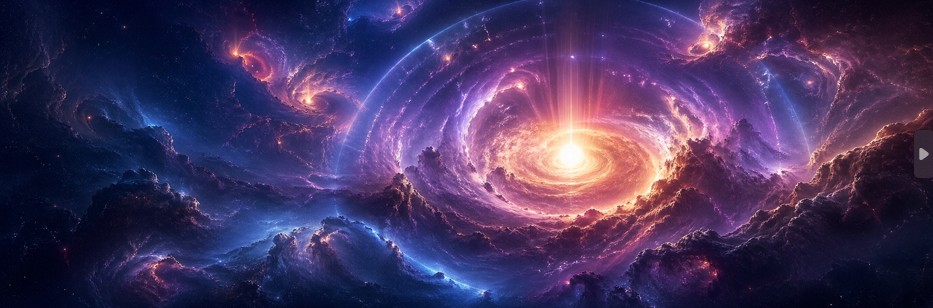
These contrasts gradually shape a cosmic relief: basins where matter gathers, separating ridges, connecting filaments and regions that empty out. In my intuition, this architecture concerns both the distribution of matter and the organization of its supporting spationic medium.
The deformations envisaged in Cosmology enter here. The encompassing domain could help form or maintain gravitational basins in our spacetime. Visible matter would organize within them. Part of what we attribute to a dark halo could express a relief of the medium, to which material assemblies weakly coupled to our light might also contribute.
Stars as sustained organizations
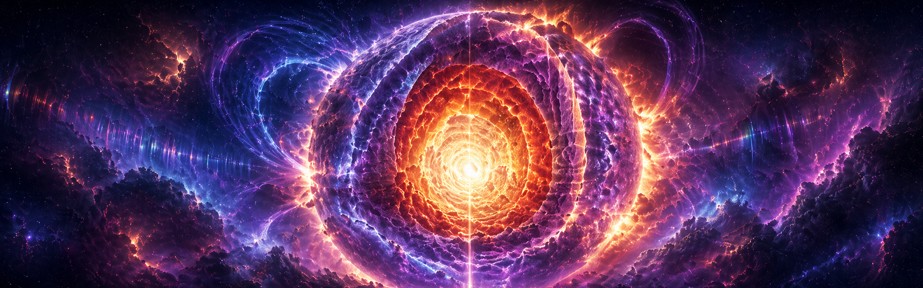
A star is a lasting organization linking compression, nuclear transformations and energy removal. In CdR, these processes involve the same medium: particles, nuclei and photons are spationic organizations interacting under particular pressure and density conditions.
I interpret stellar ignition as the establishment of a regime in which core transformations can sustain radiation. The threshold sought therefore concerns exchanges between compressed matter and its medium, beyond a temperature value alone.
A star’s layers correspond to different conditions of these exchanges. The core transforms nuclear configurations; peripheral regions transport and redistribute energy until emission. Overall stability depends on the compatibility of these regimes.
In this reading, nucleosynthesis transforms material organizations. Nuclei rearrange, certain assemblies stabilize and energy differences transfer to the medium, radiation and neutrinos, depending on the reactions. Nuclear stability thus becomes a question of internal structure and circulation, extending CdR’s proposals about particles.
Regime breakdown and redistribution
When a stellar organization can no longer sustain its maintaining conditions, it changes regime. Compression can then cause rapid reorganization of the core and surroundings.
I see core-collapse supernovae as manifestations of this breakdown: a long-sustained structure loses stability and abruptly redistributes matter and energy. The core and outer layers follow different paths. Some material remains concentrated, while some returns to the surrounding medium.
This redistribution connects generations of astrophysical objects. Forms dissolve, but their constituents feed other organizations. On galactic scales, stellar formation, activity and destruction continuously transform the medium.
The black hole as a transit regime
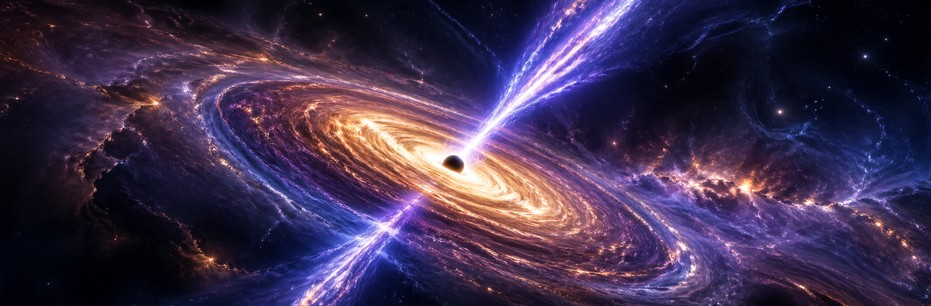
The black hole has a particular place in CdR. I envisage it as a single-vortex transion: absorbed matter’s organizations cease to persist separately and join a dominant transit structure.
This transion passes all spation flavors of our spacetime. Its size corresponds to its passage capacity: it is defined by the number of spations it can transfer simultaneously. Black-hole growth thus expresses the widening of a transit structure.
In this intuition, collapse does not endlessly fill an internal reservoir of compressed matter. It leads to a passage through which spations leave our spacetime. Gravitational concentration expresses the activity and organization of this extreme regime.
This reading excludes the accumulation of infinitely dense matter. It connects black holes to transions envisaged at particle scales, while giving the single vortex a role distinct from stable material organizations.
The connection to the encompassing domain becomes meaningful here: what appears as drainage in our spacetime could correspond there to release or emission of spations. The black hole would participate in circulation between CELA’s dimensional regimes.
Around the transit: disks, jets and compact objects
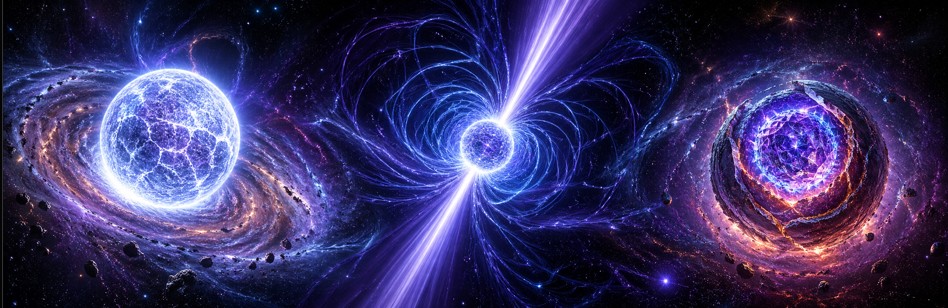
The accretion disk and jets belong notably to the black hole’s material environment. They form where matter rotates, compresses and exchanges energy before reaching the transit regime.
In CdR, this environment interfaces between still-differentiated material organization and the dominant vortex. Rotation and fields distribute flows: some converge toward transit, while others evacuate matter and energy along preferred directions. Jets extend this redistribution far beyond the central region.
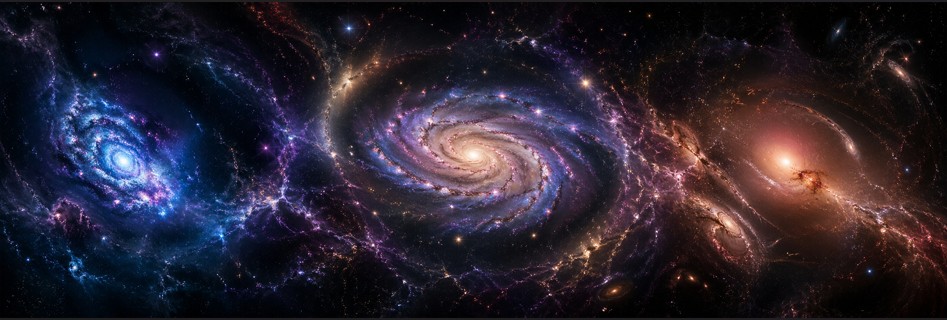
Neutron stars, pulsars and magnetars occupy another position. They retain material organization under extreme compression, rotation and magnetism. Their interest for CdR lies in this persistence: how far can material structure reorganize while remaining distinct from single-vortex transit?
Their variations and disruptions can illuminate thresholds between these regimes. They allow investigation of the coupling between internal organization, medium flows and observable manifestations.
Galaxies within CELA’s cycle
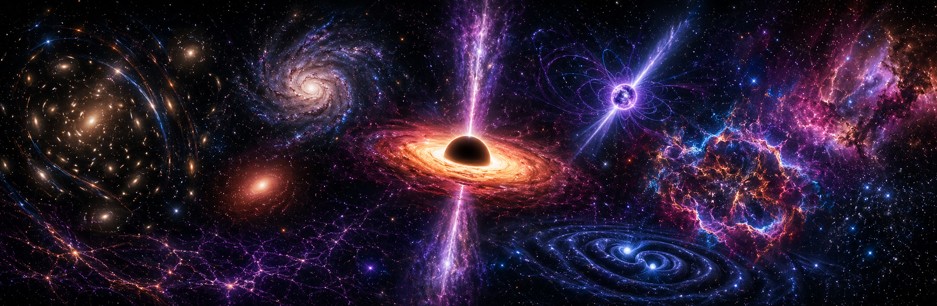
A galaxy brings together these transformations over long periods. Matter concentrates, forms stars, transforms and redistributes. Compact objects and nuclear activity in turn modify the conditions of its evolution.
In my intuition, this local history remains connected to the cosmic relief hosting the galaxy. Basins, filaments and exchanges with the encompassing medium would participate in its confinement and evolution. The galaxy also transforms the conditions supporting its own organization.
The cosmological cycle gives these transformations broader scope. Astrophysical forms temporarily accumulate matter and complexity, sustain them, then redistribute them. They are transient organizations of CELA whose activity connects particle, stellar and cosmic scales.
CdR’s sought contributions thus concentrate on several questions: the physical nature of gravitational basins, the organization of stellar transformations, stability thresholds of compressed matter and black holes as transit. These mechanisms must give this reading of astrophysics its own content.
Further exploration
The documents develop the chapter’s physical proposals, their balances and possible comparisons with observations.
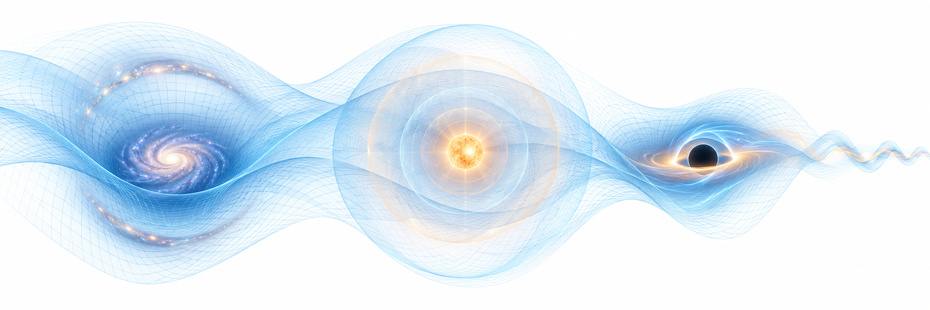
- image081 — From Cosmology to Astrophysics — Post-Bounce Protomatter
- image082 — First post-rebound contrasts — amplification and beginning of structures
- image083 — Post-rebound relief of the cosmic medium — basins, ridges, filaments and void bubbles
- image084 — Stellar ignition — internal thresholds of the Φ field
- image085 — Internal structure of stars — core, transport and coherence regimes
- image086 — Stellar nucleosynthesis — nuclear coherence and core transformations
- image087 — Supernovae — coherence rupture and redistribution of matter
- image088 — Black holes — single-vortex transion and spationic transit
- image089 — Accretion disks and relativistic jets — rotation, transit and axial evacuation
- image090 — Intermediate objects — pulsars, neutron stars, exotic cores
- image091 — Evolution of galaxies over a cosmic cycle
- image092 — Observable signatures of CdR astrophysics
These documents clarify the chapter’s proposals, their foundations and the conditions for examining them.