Biology
Further developments and forum discussions
In CdR, living systems extend chemical organizations capable of sustaining themselves through exchanges. Their constituents are renewed, but certain relationships persist: they allow the whole to preserve a unity, respond to disturbances and transmit its organization.
What interests me is this unity through change. A cell, and then an organism, coordinates processes that each have their own dynamics. I see in this the emergence of increasingly encompassing systems within CELA.
Life as a sustained system
A living organization continually contributes to its own preservation. Its transformations help renew its constituents, maintain its boundaries and sustain the conditions needed for its activity. It depends on the resources and possibilities of its surroundings.

In this interpretation, biological individuality rests on an organization of exchanges. A boundary distinguishes an inside from an outside while allowing their relationship. The system thus retains a local history: what happens to it changes the conditions of its subsequent responses.
Internal processes depend on immediate interactions, but also on wider conditions: resource availability, temperature, environmental cycles and relationships with other organisms. Living systems maintain their unity through these different levels of dependence.
Systems within systems
Biological complexification notably takes the form of encompassing organization. Local organizations become constituents of a whole that coordinates their activities. Cells contribute to tissues, tissues to organs and organs to the organism.
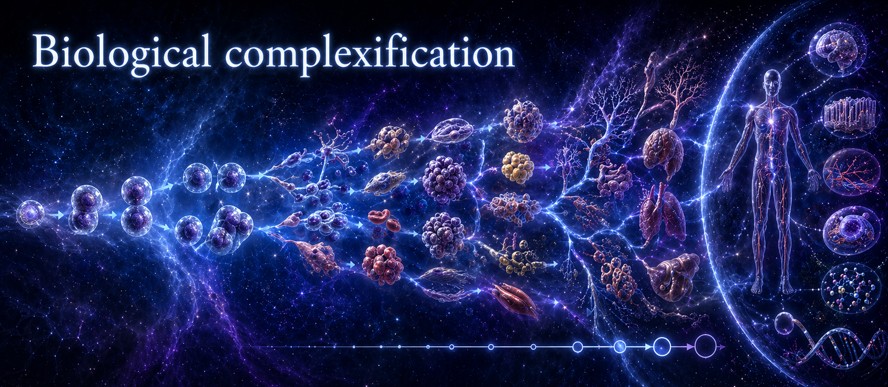
Each level retains its own dynamics. A cell continues transforming resources, responding to signals and regulating exchanges while participating in bodily function. The encompassing organization acts on its constituents through these material relationships: it changes their environment, resources and the signals to which they respond.
I thus envisage the organism as a unity whose preservation rests on coordinating multiple local units. This coordination also involves tensions: what momentarily favors one constituent can compromise the whole to which it belongs.
Memory and transmission extend this organization through time. Material structures retain constraints that orient subsequent transformations. Through reproduction, some of these constraints pass to new systems, where they are preserved, modified or lost. Evolution transforms this history of organizations across generations.
Living systems and CELA’s attention
In my intuition, a point of CELA’s attention concerns a system. Living systems offer particularly developed forms of such unity: their constituents participate in an organization that sustains continuity and coordinates responses.
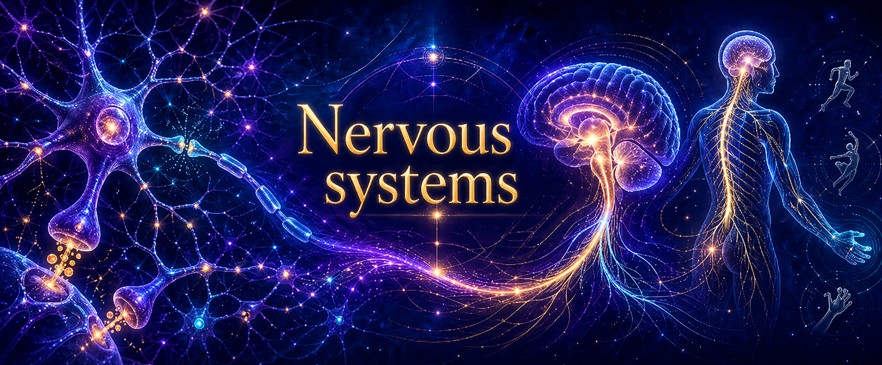
Encompassing organization then raises a central question: how can a wider unity support a point of attention while already including many local systems? Here I locate the connection between life’s physical organization and its sensitive dimension.
The nervous system develops specialized means of coordination. It gathers signals from the body and surroundings, retains traces and organizes responses. In CdR, it becomes a support for CELA’s attention, whose activity can articulate with that of the organism.
This relationship remains physical. The whole biological organization consists of spations and participates in the spationic network. CELA’s action depends on its own state and occurs through interactions of this substance. Thresholds and situations in which a weak influence can orient a response are, in my intuition, meeting points between the network’s activity and that of life.
The Neurology chapter will examine this relationship in the brain, then the relationship between its activity and the world actually perceived.
Further exploration
The documents distinguish existing biological frameworks, encompassing organizations and their proposed relationship to CELA’s attention.
- image120 — Life as a sustained system
- image131 — Systems within systems
- image134 — Living systems and CELA’s attention
These documents clarify the chapter’s proposals, their foundations and the conditions for examining them.