Psychophysics

After establishing the fundamental attributes of the Substance, it becomes necessary to examine its two direct expressions: material organization and lived organization. In Consciousness of the Real (denoted CdR), these two regimes are neither separated nor hierarchized: they constitute two simultaneous faces of a single process. Psychophysics therefore describes how the Real manifests itself both as the structure of the world and as the experience of the world, prior to any mental elaboration. It is the point of junction between physics and lived experience, indispensable for understanding the sections that follow.
Physical Products
To understand what follows, it is necessary to grasp the notion of spatial dimension. We live in a three-dimensional world (3D, e.g., m³), where every object has a length, a width, and a height. For example, a box can be described by these three measures. A one-dimensional space (1D, e.g., m or m¹) can be imagined as a straight line, like a ruler. A two-dimensional space (2D, e.g., m²) corresponds to a flat surface, like a sheet of paper. Our brain naturally perceives these three dimensions through vision and movement, which allows us to navigate the world. In scientific or philosophical contexts, the notion of dimension can extend to more abstract ideas: a fourth dimension (time) or even theoretical dimensions beyond our ordinary perception.
Let us now represent the substance of the Real in its simplest conceivable state, and observe how this state complexifies and what physical products and notions emerge from this complexification.
The simplest conceivable state is one in which all the substance of the Real (denoted CELA) is in a state of maximum density, without internal differentiation.
I illustrate it as a point, not in the geometric sense, but as a configuration in which no discernible spatial extension is yet present.

But by its property of being dynamically substantive, CELA cannot remain in this state of maximum density. It must extend. If it does so along one dimensional axis, it forms a line; along two axes, a surface; along three axes, a volume. But why stop at three axes? Or at four? A priori, the substance should be able to deploy along as many dimensional axes as necessary to directly reduce its state of density, that is, to distribute its being more extensively. Now, calculating the variation of the volume of a hypersphere as a function of the number of dimensions indicates a maximum located between five and six axes:
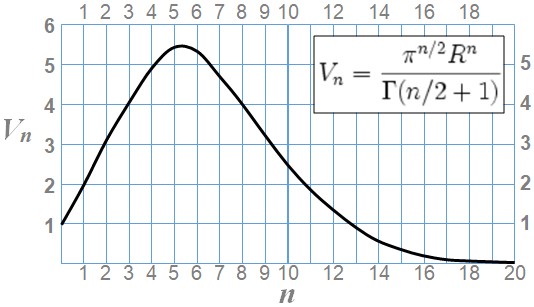
Let us see whether this indication of 5 or 6 axes will be useful to us.
Starting from a state of maximum density, illustrated as a point, imagine that CELA extends along one dimensional axis:
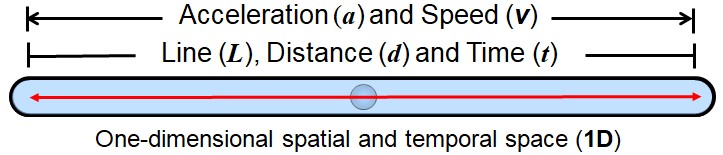
All these physical notions—acceleration, velocity, distance, and time—proceed from the exploitation of a single fundamental dimensional axis.
Why include time? Because without time, CELA could not deploy: it would remain in a state of maximum density, without any possible actualization.
This first dimension, both spatial and temporal, therefore corresponds neither to one of our Euclidean dimensions (x, y, z), nor to the temporal dimension of relativity (3 spatial + 1 temporal).
Our usual dimensions of space and time can only be derived products of the fundamental dimensions—effects of the internal dynamics of CELA.
Since CELA exists at every point of the spatial and temporal space it generates, and since this space is finite but entirely filled by this substance, we can represent each portion of space as composed of multiple points of CELA. These points are not isolated, but in permanent interrelation.
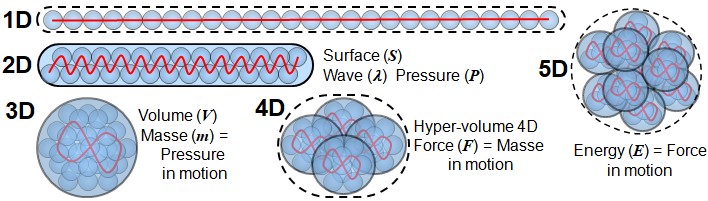
Now imagine that, to reduce its density, our line of points gradually passes from 1D to 5D. This will produce interactions, internal tensions, dynamic exchanges—in short: effects. We can represent this complexification as a progressive construction of structures, each level exploiting more dimensional axes:
- 1D: a line made of points. Interaction between points on this line gives rise to notions such as distance, velocity, and acceleration.
- 2D: a surface made of lines of points. The lines interact within this surface, giving rise to waves, pressure, and the first forms of spatial structuring.
- 3D: a volume constituted by interacting surfaces. Here appear notions such as volume and mass (viewed as pressure in motion).
- 4D: a hyper-volume where 3D volumes interact across three additional dimensions. This dynamic relation of masses gives rise to forces.
- 5D: when these forces are exerted over distances in a hyper-volume, they give rise to energy, viewed as force in motion.
In other words, at each level of interaction between dimensional structures, new physical notions naturally emerge. The fundamental relations of physics indicate that all these notions classify at the dimensions indicated, each notion (e.g., force, energy) indeed arising from the exploitation of that number of dimensional axes.

Thus, each physical quantity is situated at an axial dimensional level. For example, force is at level because:
with and ,
hence:
Likewise, energy is at level because:
and ,
thus:
So why is velocity, which designates a ratio between distance and time (), not of dimension zero? Because we are dealing here with axial dimensions. How many axes are required to indicate an acceleration, a velocity, a distance, or a time? Only one. Therefore, all these notions—distance, time, velocity, and acceleration—can only be of dimension 1. They all exploit one and the same generative axis: the one that simultaneously opens minimal spatial extension and elementary temporal flow. Thus, by extending itself, CELA does not merely produce space: it generates laws, dynamics, structures. This point is crucial: physical laws are not external to the substance, but are the very effects of its dimensional deployment. That is why each new axial dimension exploited by CELA gives rise to new notions—and, ultimately, to our physical reality.
That said, it is clear that we do not live in these dimensional spaces. It would be more accurate to say that we are made of them, as is the spacetime in which we live. We will return to this in the pages devoted to physics. But for now, rather than trying to imagine what a substance extending across multiple dimensions both spatial and temporal might look like, let us see what its psychic products are.
Psychic Products
Up to this point, we have followed the physical deployment of CELA (point, line, surface, volume, time). But according to CdR, the physical and the psychic are not separated—they are two faces of the same process. Let us now observe how this same dimensional structure manifests itself in lived experience, taking vision as an example.
In this model, there are not two realities—one “material” and the other “mental”—but a single substance in deployment, named here CELA. The physical world and consciousness are therefore not separated: they are two ways for this same reality to express itself.
In other words, what we call “matter” and what we call “mind” are not two different domains, but two perspectives on a single process. The Real is neither purely material nor purely mental: it is psycho-physical by nature.
This unity explains why the forms of organization we have observed in the physical world—from simple structures to complex systems—are also found in the way perception is constructed. Consciousness is not something added to the world: it is a way for the Real to recognize and structure itself through us.
Starting from our minimal certainty—the perception of something changing—we can approach conscious perception as a product not of an independent matter, but of the same unique substance that we have seen give rise to space, time, and physical laws.
If everything that exists proceeds from one and the same substance—here named CELA—there can be no truly separate subject from object, nor any “perceiver” external to reality. What we call consciousness is not a distinct entity, but a particular mode of organization of this same substance. In other words, consciousness is not added onto the universe: it is an emergent property of it, arising from the progressive deployment of CELA along determined axes of complexification.
Starting again from our minimal certainty—the perception of something changing—we can approach conscious perception as a product not of an independent matter, but of this same unique substance that we have seen generate space, time, and physical laws.
By applying to the perceptual domain the same method used for physical products, one can suppose that perception itself also emerges from a progressive complexification along certain axes. The following table, though schematic, proposes an outline of this progression: to each new perceptual axis corresponds the birth of an additional structure of discernment.

Thus understood, conscious perception is a dynamic construction. It results from a series of differential operations, each founded on the recognition of a perceptible difference and organized along a specific axis. These discernments structure both our experience of the external world and that of the internal world: they constitute the mechanisms by which CELA, through us, differentiates itself, explores itself, and recognizes itself.
The progression D¹–D⁸ is ontological in nature, not merely descriptive or functional. It does not represent an operation of the human mind, but the structure of the Real in act. Human cognition merely reflects its functioning, because it is a local expression of it. In other words, ontology generates cognition, not the reverse.
Consciousness (D⁵) is not “produced” in a causal sense, but emerges from the first complete reflexive relation of the CELA field to itself. D⁵ designates the ontological threshold at which perception becomes simultaneously perceived and perceiving—the minimal form of consciousness. It is therefore not an external causality, but a necessary self-configuration of the system when it reaches full reflexivity.
From this structure it follows that perception necessarily implies existence, but the converse is not true. The perception of perceiving—formulated as (something feels something)—is constituted of elements less complex than the perception of existing—(being something). By grouping the first two elements ((something feels) something), one shows that perceiving implies being; but to establish the inverse, one would have to decompose being something, which can just as well designate an object ((feels something) something) as a subject ((something feels) something). Thus, depending on how one combines and recombines the elements of a same perception, one passes from one truth to another, without these truths being immediately reducible to one another. The following table illustrates this combinatorial logic.

By manipulating the basic elements of the perceived (something, feels, being), one recovers the principal notions of the universe of ontological discourse—existence, consciousness, percipience, etc. This same method can be applied to other domains of experience: for example, to the adverb “intense” in the thermal field. One then finds structural correspondences between physical, perceptual, and linguistic notions.

This table highlights these correspondences in the thermal discourse universe. It illustrates how a same scheme of complexification can manifest across different orders: the physical (amplitude, pressure, energy…), the psychic (intensity, sensation, relation…), and the linguistic (intense, hot, heating…). These correspondences do not stem from a simple analogy between language and world, but from an ontogenetic homology: language, in its very structure, proceeds from the same movement of self-differentiation as the Real it expresses. In other words, language does not imitate reality—it emerges from it, as a reflexive form of its internal organization.
This convergence suggests that the Real possesses a double psycho-physical nature, in which the mental and the material are only two expressions of a same fabric of differentiation. >But is all terminology really conditioned by these eight levels? I could give other examples (D2: just ⟶ the just or judge ⟶ to judge ⟶ judgeable ⟶ justice ⟶ judicial ⟶ judiciously), but the best way I know to show it still lies in the use of a neologism. For example:
Semantic gradient of “bob” (D2–D8)
-
D2 — bob (sensation)
Immediate quality: direct qualifier expressing a sensible property or perceived state.
Example: a bob atmosphere. -
D3 — Bob (object/subject configuration)
Individual entity: particular instance embodying the “bob” quality.
Example: that Bob there manifests the essence of bob. -
D4 — bob to bob (transition)
Action / process: the act of manifesting bob, of producing or operating according to this quality.
Example: he bobs as soon as he speaks. -
D5 — bobbing (relation)
Ongoing process: that which manifests the quality in a dynamic and interactive way.
Example: a bobbing presence. -
D6 — bobism (principle)
Operative principle: structuring archetype at the origin of bob-like manifestations.
Example: bobism is not an ideology, but the internal law of bob. -
D7 — bobber (system)
Organization of the principle: operating system or agent structuring the bob principle.
Example: the bobber realizes and systematizes bobism. -
D8 — bobment (context)
Field of expression: ontological context or global mode in which bob is expressed.
Example: to act bobment = to act within the field of bob.
One should not believe that this classification applies only to European languages. The D1 → D8 scheme does not rest on the existence of a chain of lexical derivations in a given language, but on a conceptual principle: each perceptual “dimension” adds a level of structuring—intensity, relation, system, context, etc. In French or English, morphology makes these steps visible through derivations (just → justice → judicial → judiciously). But in isolating or agglutinative languages, these same steps can be expressed by distinct words or syntactic constructions, without the conceptual logic changing. Thus, the linguistic correspondences proposed here have no value as universal law: they serve as heuristic illustrations of the internal coherence of the model.
For example, in Chinese or Japanese, the progression exists, but it is often realized through lexical composition or particles and adverbs rather than suffixation. What varies is the grammatical support, not the logic of passage from one dimensional axis to another.
This model does not assert an a priori truth: it proposes a coherence to be tested. Should it be studied—and if comparative linguistic analysis were to show that this hierarchy does not exist—it would have to be concluded that the model describes not the structure of the Real, but only the structure of our thinking about the Real. Its linguistic falsifiability makes it an instrument of verification, not of belief: the more natural languages confirm this progression without exception, the more the axial hypothesis is strengthened.
That said, the eighth level takes on a particular importance for problem solving. For example: you would like to feel warmer? Here are the solutions:

The perceptual combinations illustrated here are not recipes, but manifestations of a same organizational structure. Psychophysics thus shows how CELA, in deploying itself, simultaneously produces the form of our experience and the internal logic of the world.
This section introduces the physical and psychic bases of the Real according to CdR.
We will now explore each of these two aspects in greater detail, and enter into what they allow us to glimpse of what is truly extraordinary in the world around us.
Further Reading
This popular presentation is based on a technical corpus formalized in more than 255 documents. To examine the rigorous foundations of the CdR model:
- image001 — Fundamental attributes of the Substance of the Real
- image002 — Minimal psychophysical distinction
- image003 — Proto-metric and spatial emergence
- image004 — Dimensional optimum and internal stability
- image005 — Spatio-temporal axes and associated dynamics
- image006 — Physical capacities derived from organizational degrees
- image007 — Axial table of correspondences
- image008 — Psychophysical deployment
- image009 — Thermal correspondences
- image010 — Table of thermal modes
- image011 — Perceptual methods (D² → D⁸)
These documents include mathematical formalisms, falsifiability criteria, and academic references.